EHR AI Studio Dashboard: Internal User-Centered Design

Updated: Nov 4, 2025
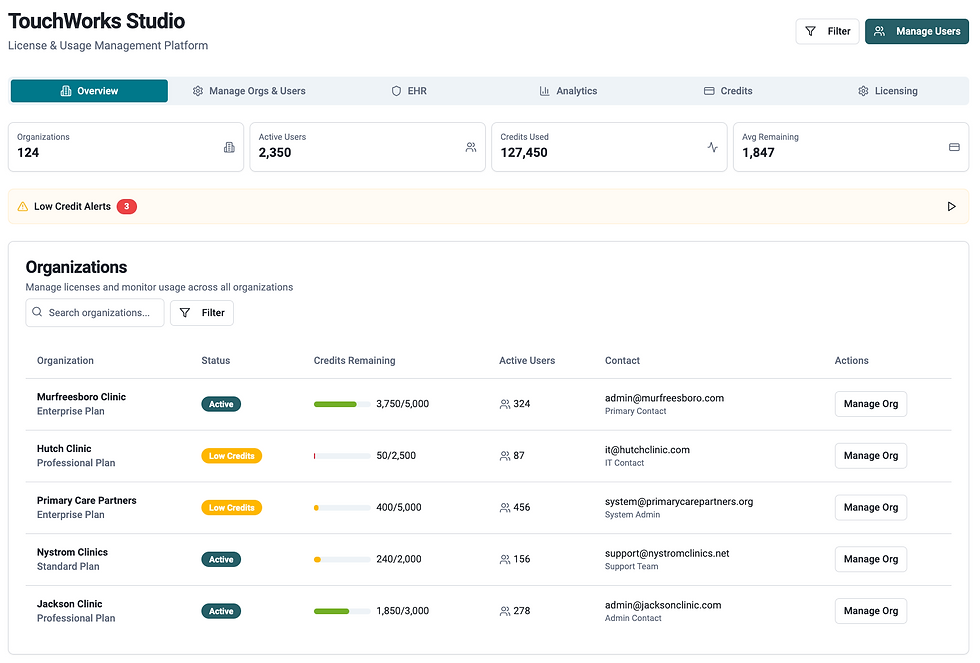
Led the design, AI prototyping, research, and GTM of TouchWorks Studio License and Token Admin Tool, a comprehensive enterprise dashboard for managing healthcare organizations, user licenses, AI token usage, EHR integrations, and tool assignments. The platform serves as the administrative backbone for our SaaS product, requiring careful balance between feature density and usability.
The Challenge
Healthcare administrators needed a unified interface to manage:
Multi-organization hierarchies with different AI subscription tiers
User provisioning and license allocation across tools
EHR system integrations and data synchronization
Token usage analytics and credit consumption tracking across AI apps
Role-based access controls and compliance requirements
Design Approach
Rather than traditional external user testing, I leveraged our internal team as a specialized user group. This approach provided:
Deep Domain Knowledge and Persona Coverage: Users understood healthcare workflows and compliance needs
Rapid Iteration Cycles: Daily feedback loops instead of weekly sessions
Authentic Use Cases: Real-world scenarios with actual production data

Key Features Delivered
1. Streamlined Organization Selection
Removed redundant modal dialogs and consolidated org selection into a single, persistent workflow. Users can now switch contexts seamlessly without losing their place.
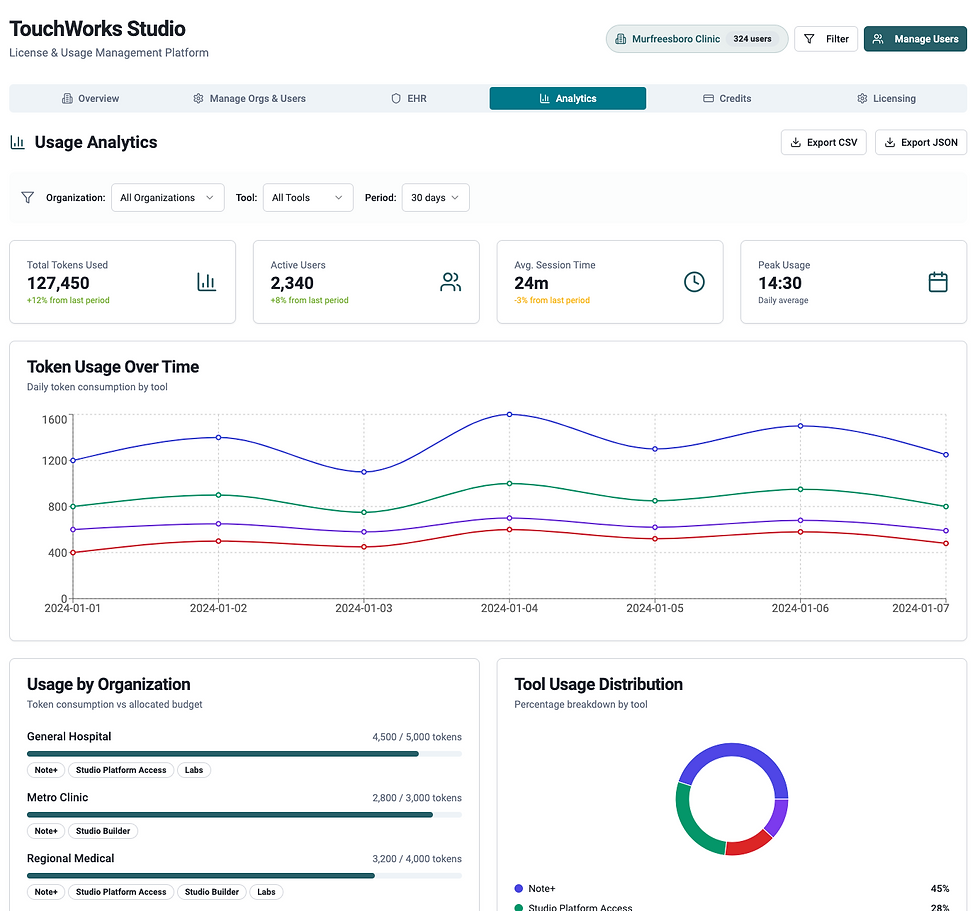
2. Context-Aware Navigation via Style Guide and AI UX Tool Prototyping
Implemented a persistent organization banner using EHR style guide to ensure users always know their current context—critical for preventing cross-organization data errors.

3. Multi-Module Dashboard
Built tabbed interfaces for:
User Management with bulk operations
Tool Assignment with trial mode controls
Time Tracking and usage analytics
EHR Integration status monitoring
License compliance and alerts
Technical Implementation
Stack: React, TypeScript, Tailwind CSS, Radix UI
State Management: React hooks with persistent context
Design System: Custom component library with consistent patterns
Accessibility: WCAG 2.1 compliant with keyboard navigation
Results & Impact
Reduced onboarding complexity by 40% through consolidated workflows
Eliminated cross-organization errors with persistent context indicators
Improved task completion time for common admin operations
Positive internal feedback led to feature expansion roadmap
Lessons Learned
Internal users provide unique value: Their product immersion revealed edge cases external testers would miss
Consistency matters at scale: With 10+ sub-modules, visual and interaction patterns became critical
Context preservation prevents errors: In multi-tenant systems, always-visible org context reduced mistakes significantly


Comments