Reducing Clinical Documentation time with AI-Powered Workflows

Clinicians spend 2+ hours daily typing notes, often during patient encounters, breaking eye contact and diminishing the human connection that's fundamental to care.

The Innovation: AI Note+ (Ambient Listening)
Led the design and GTM activities of AI Note+, a revolutionary ambient listening system that fundamentally transforms how clinical documentation happens:
Intelligent Voice Capture & Processing:
Ambient recording that naturally captures patient-provider conversations without disrupting the flow of care
Real-time AI transcription with medical terminology recognition and context awareness
Smart speaker diarization that distinguishes between provider, patient, and family voices
Automatic note structuring that transforms conversations into properly formatted SOAP notes
Context-aware sections that populate HPI, ROS, Physical Exam, and Assessment/Plan based on conversation content
AI-Powered Intelligence Features:
Clinical entity extraction identifying medications, conditions, symptoms, and procedures mentioned
Temporal reasoning that understands "since last Tuesday" or "for about 2 weeks"
Negation detection recognizing "no fever," "denies chest pain," etc.
Automated coding suggestions for CPT and ICD-10 based on documented encounter
Care gap identification flagging missing screenings or follow-ups mentioned during visit
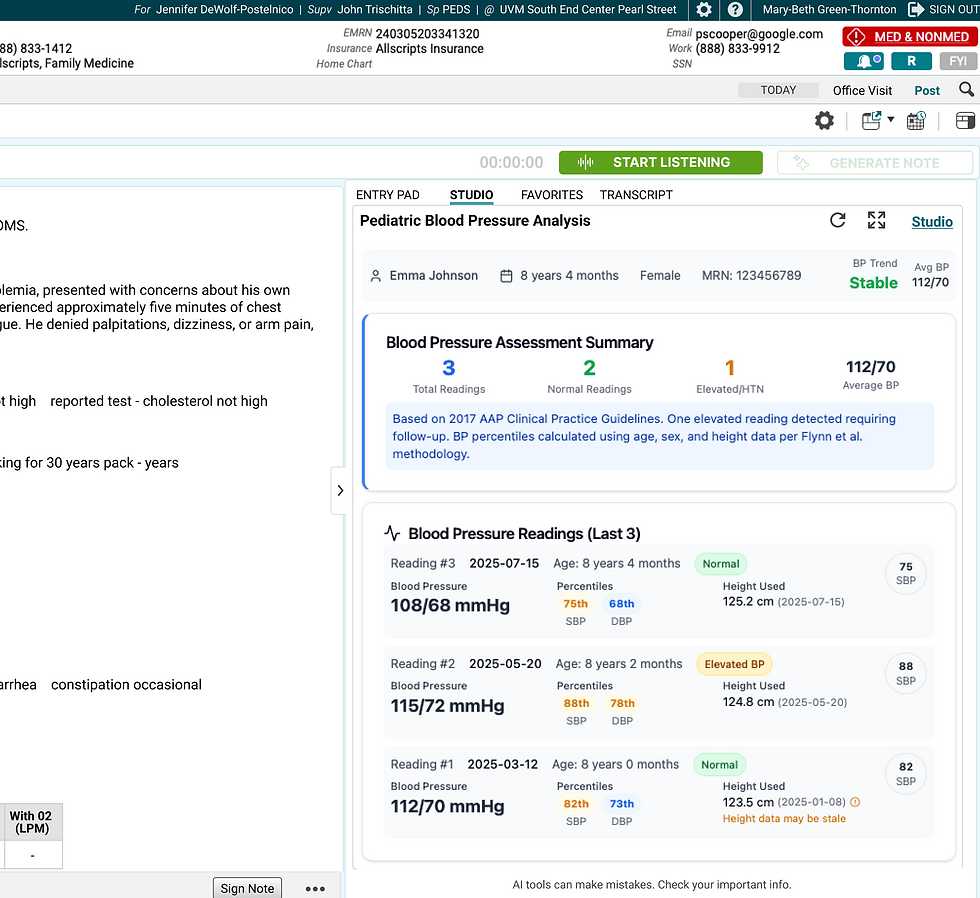
Design Philosophy: Invisible Yet Transparent
The core principle behind AI Note+ is that documentation should be invisible during the encounter but transparent in its process. The AI works quietly in the background while maintaining complete clinician control and oversight.
Key UX Innovations
Persistent Recording Indicators:
Red recording banner visible across all screens - providers always know when ambient listening is active
Subtle pulsing animation that confirms active recording without being distracting
One-tap pause/resume for private discussions or sensitive moments
Duration counter showing recording length for billing documentation
Trust Through Transparency:
AI confidence scoring on each generated section (high/medium/low)
Source attribution linking generated text back to specific conversation moments
Edit tracking showing what AI generated vs. what clinician modified
Learning indicators when AI adapts to individual provider preferences
Seamless Review Workflow:
Side-by-side view of transcript and generated note
Quick correction tools for common AI mistakes
Template integration preserving existing documentation preferences
One-click acceptance for accurately generated sections
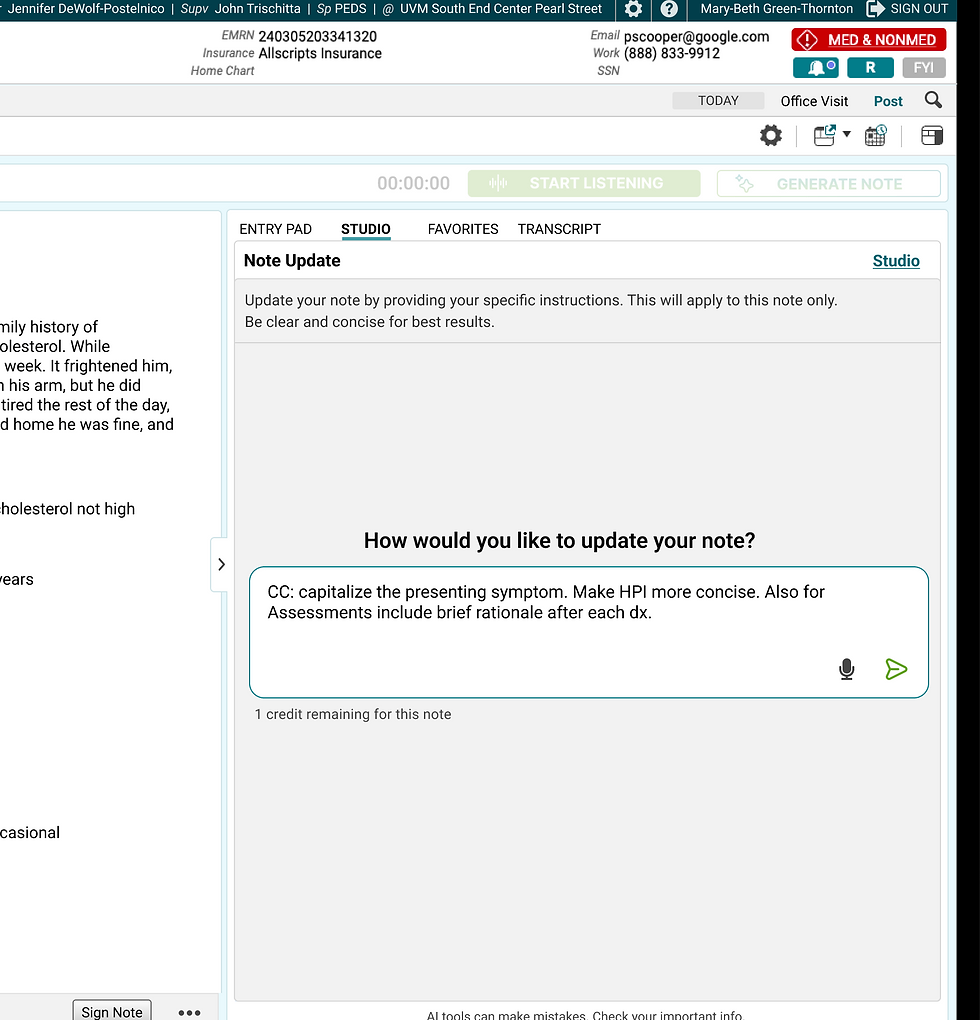
Rapid Prototyping with Clinicians
My approach centered on direct collaboration with practicing physicians, using AI-powered design tools to iterate in real-time:
Shadow sessions observing actual patient encounters to understand conversation flow
Live testing with physicians using prototypes during simulated visits
Real-time adjustments modifying the AI prompts and UI based on immediate feedback
Voice pattern analysis to optimize for different speaking styles and accents
Specialty-specific customization for pediatrics, internal medicine, and specialists

The AI Architecture Behind the Experience
Multi-Model Approach:
Primary transcription model for accurate medical speech-to-text
Clinical NLP model for entity extraction and relationship mapping
Note generation model fine-tuned on thousands of clinical notes
Quality assurance model checking for inconsistencies and errors
Privacy & Compliance First:
On-device processing options for sensitive encounters
HIPAA-compliant data handling with automatic PHI detection
Consent workflows built into the patient check-in process
Audit trails for all AI-generated content
Impact & Real-World Results
Quantitative Outcomes:
60% reduction in documentation time (from 10 minutes to 4 minutes per encounter)
40% decrease in after-hours "pajama time" documentation
85% first-pass accuracy requiring minimal editing
92% provider satisfaction in pilot programs
Qualitative Transformations:
Providers report "feeling like doctors again" with restored eye contact
Patients feel more heard and engaged during visits
Reduced physician burnout scores
More detailed and comprehensive documentation
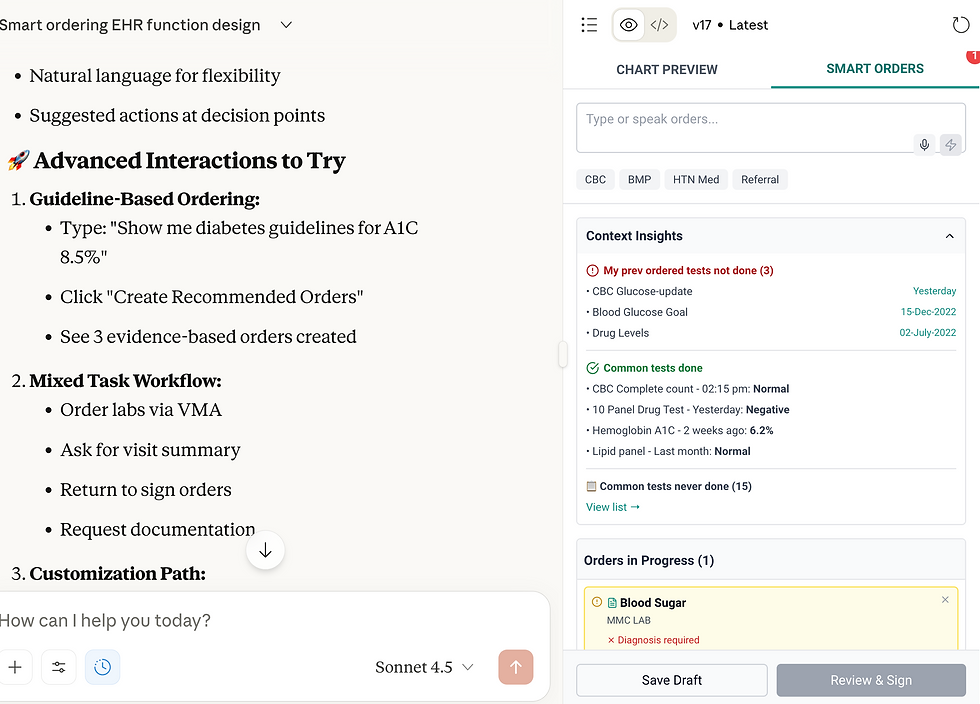
Complementary Innovation: Smart Ordering
While AI Note+ handles documentation, our Smart Ordering System streamlines the ordering process with AI-powered predictions and context-aware suggestions, creating a complete AI-enhanced clinical workflow. Together, these tools save providers over 20 minutes per patient encounter.
Why This Matters
AI Note+ represents a paradigm shift in clinical documentation. By removing the keyboard from the examination room, we're not just saving time – we're fundamentally restoring the human connection in healthcare. Physicians can focus entirely on their patients, knowing that AI is capturing and structuring the encounter accurately in the background.
This isn't about replacing clinical judgment with AI – it's about using AI to eliminate the mechanical aspects of documentation so providers can focus on what they do best: practicing medicine.

Technologies: Azure Cognitive Services, OpenAI GPT-4, Custom Clinical NLP, WebRTC, React, TypeScript, FHIR
Methodologies: Ambient Computing Design, Shadow Observation, Real-Time Clinical Testing, AI-Assisted Rapid Prototyping


Comments